Asphalt Driveway Calculator
Measure each section up to the shared corner only. Do not overlap or double-count the corner space where the two sections meet.
Standard residential driveways use 2.5 to 3 inches compacted. Always enter the finished compacted depth, not the loose placement depth.
Know your tonnage? See the full installed cost.
Driveway Cost Estimator →Standard hot mix asphalt density
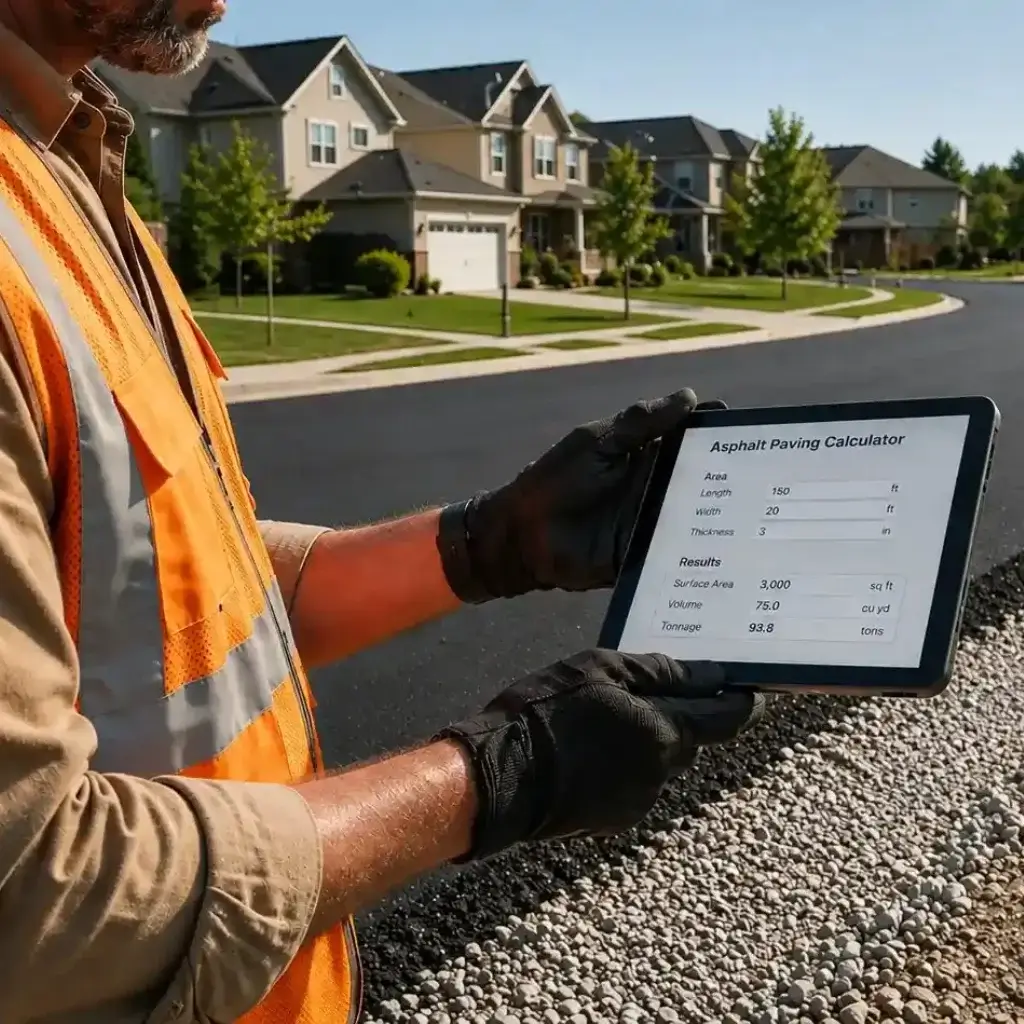
Enter your driveway length, width, and planned thickness. The calculator converts those measurements into volume (cubic feet) and weight (tons) — the number your supplier uses to price and deliver the material.
New Driveway or Overlay toggle: Switch to Overlay mode if you're resurfacing an existing solid base. Enter only the new layer depth, not the depth of the existing pavement.
Know your tons? See what it will cost → Driveway Cost Estimator
What Is an Asphalt Driveway Calculator?
An asphalt driveway calculator is a tool that estimates how many tons of asphalt you need for a driveway project. It takes your driveway dimensions and planned thickness, converts them into volume, and then applies the standard asphalt density to give you the material weight your supplier needs to process your order.
Homeowners use it before requesting paving quotes. Contractors use it to build material orders. Project planners use it to compare layout and thickness options before committing to a design.
How This Calculator Works
The calculator follows three steps:
Area
Length × Width = Square feet
Volume
Square feet × Thickness (in feet) = Cubic feet
Tons
Cubic feet × 145 lb/ft³ ÷ 2,000 = Tons
The formula:
Tons = (Length × Width × Thickness in feet × 145) ÷ 2,000
The 145 figure is the weight of one cubic foot of compacted hot-mix asphalt in pounds, the standard used across US paving projects.
Worked Example
A driveway 40 ft long, 20 ft wide, paved at 3 inches thick:
- Area: 40 × 20 = 800 sq ft
- Thickness in feet: 3 ÷ 12 = 0.25 ft
- Volume: 800 × 0.25 = 200 cu ft
- Weight: 200 × 145 = 29,000 lb
- Tons: 29,000 ÷ 2,000 = 14.5 tons
Add 10% for compaction and waste: order 16 tons.
What to Enter
Length and Width
Measure in feet. For driveways with multiple sections, measure each one separately and add the areas together.
| Section | Size | Area |
|---|---|---|
| Main driveway | 40 ft × 12 ft | 480 sq ft |
| Parking pad | 10 ft × 10 ft | 100 sq ft |
| Total | 580 sq ft | |
Thickness
Enter the final compacted depth, not the loose placement depth. If a contractor lays 3.5 inches loose to finish at 3 inches, enter 3.
| Thickness | Typical Use |
|---|---|
| 2 inches | Light residential, low traffic |
| 2.5 to 3 inches | Standard residential (most common) |
| 3 to 4 inches | Heavy vehicles, RVs, work trucks |
Overlay Thickness
If resurfacing, enter only the new layer depth — typically 1.5 to 2 inches. Using the full existing pavement depth in overlay mode doubles your estimate.
Asphalt Density
Leave at 145 lb/ft³ for standard hot-mix asphalt. Update this only if your supplier gives you a specific figure for the mix you are ordering.
How to Measure Your Driveway
Rectangular Driveway
Multiply length by width to get area. If the width changes from street to garage, average the two measurements.
Multiple Sections
Measure each section separately, calculate each area, then add them together before entering the total.
Irregular Shapes
Break the driveway into rectangles, triangles, and circles. Calculate each one, then add the results.
This calculator handles rectangular and L-shaped driveways directly — use the shape toggle above. For driveways with circles, triangles, curved turnarounds, or more than two sections, use our Asphalt Area Calculator:
Irregular Area Calculator →Quick Reference: Tons per 100 Sq Ft
| Thickness | Tons per 100 Sq Ft |
|---|---|
| 1.5 inches Overlay | ~0.9 tons |
| 2 inches | ~1.2 tons |
| 2.5 inches | ~1.5 tons |
| 3 inches | ~1.8 tons |
| 3.5 inches | ~2.1 tons |
| 4 inches | ~2.4 tons |
How to Use This Table
Multiply the tons per 100 sq ft figure by your total square footage divided by 100.
Worked Calculation
650 sq ft at 3 inches = 1.8 × 6.5 = 11.7 tons
Calculated base tonnage before applying standard waste allowance.
Why You Should Order More Than the Result Shows
Asphalt is delivered loose and compacted on-site. Rolling reduces the material's volume by 20 to 25%. Suppliers invoice by loose weight, so the tons delivered will always be more than the compacted result on the ground.
Add 10 to 15% to the calculator result before ordering.
Under-ordering means the crew stops mid-job waiting for a second delivery — a delay that usually adds a day and increases your labor cost.
Common Mistakes to Avoid
Entering Loose Depth Instead of Compacted Depth
If your planned compacted thickness is 3 inches, enter 3 — not the 3.5 inches your contractor spreads before rolling.
Forgetting Sections
A 12 ft × 12 ft parking pad adds 144 sq ft. At 3 inches, that is 3.5 extra tons. Leaving it out means running short on the day.
Using the Wrong Project Mode
New driveway means full depth. Overlay means new layer only. Swapping these doubles or halves your estimate.
Not Adding a Waste Allowance
The calculator gives you the mathematical result. Always add 10 to 15% before placing the order.